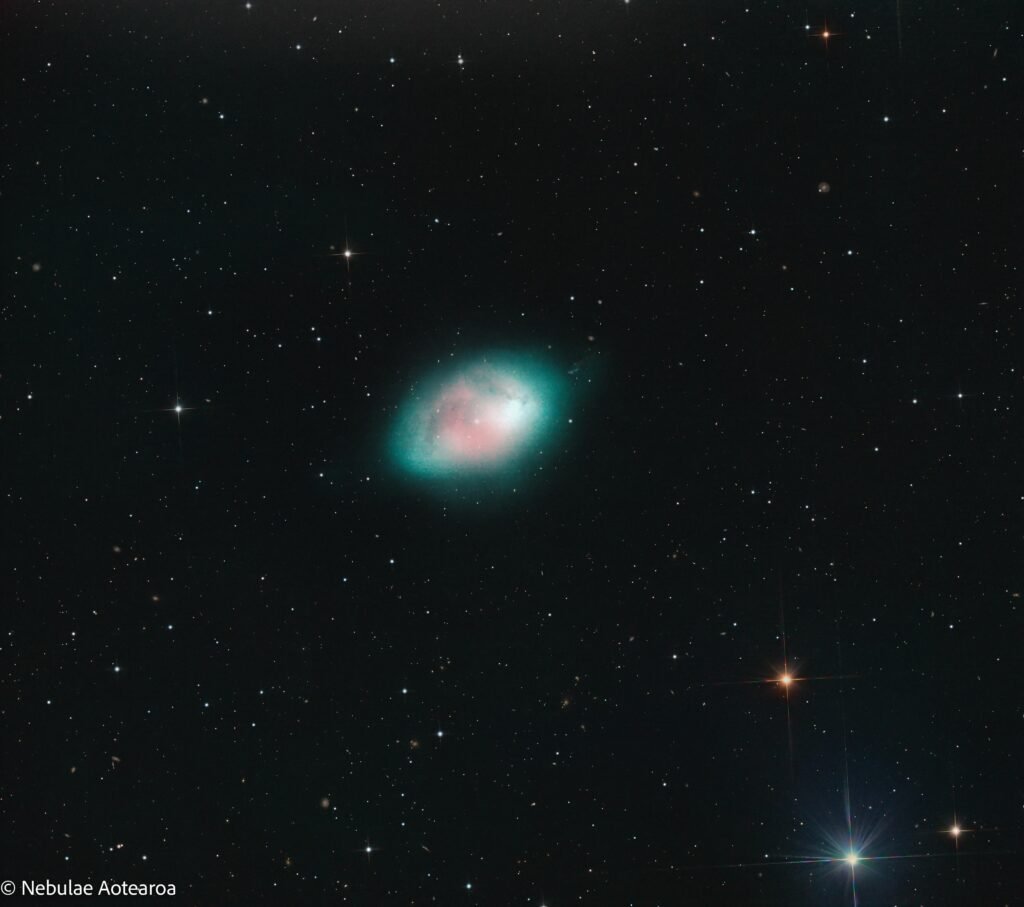
NGC 1360 — The Robin’s Egg Nebula
RA/Dec (J2000): 03h 33m 14s, −25° 52′ 18″
Constellation: Fornax
Other designations: ESO 482-18
Historical Overview
NGC 1360, nicknamed the Robin’s Egg Nebula, is a large, diffuse planetary nebula in Fornax. It was discovered by John Herschel in 1835 during his surveys of the southern skies from South Africa.
Unlike compact ring-like nebulae, NGC 1360 is unusually elliptical and extended, spanning nearly 9 light-years. Its faint, smooth appearance gives it a soft bluish glow, hence its avian nickname.
Studies in the late 20th century revealed that NGC 1360’s shell is not spherical but shaped by stellar winds and binary interactions (Goldman et al. 2004). Its central star is a hot white dwarf still ionizing the nebula’s gases.
Key Facts
- Type: Planetary nebula.
- Distance: ~1,200 light-years.
- Size: ~9 light-years across (unusually large).
- Scientific importance: Example of evolved, diffuse planetary nebula structure.
References
Acker, A. et al. (1992). The Strasbourg-ESO Catalogue of Galactic Planetary Nebulae.
Herschel, J. F. W. (1847). Results of Astronomical Observations at the Cape of Good Hope.
Goldman, D. et al. (2004). Morphology and Evolution of NGC 1360. AJ, 128, 2340.