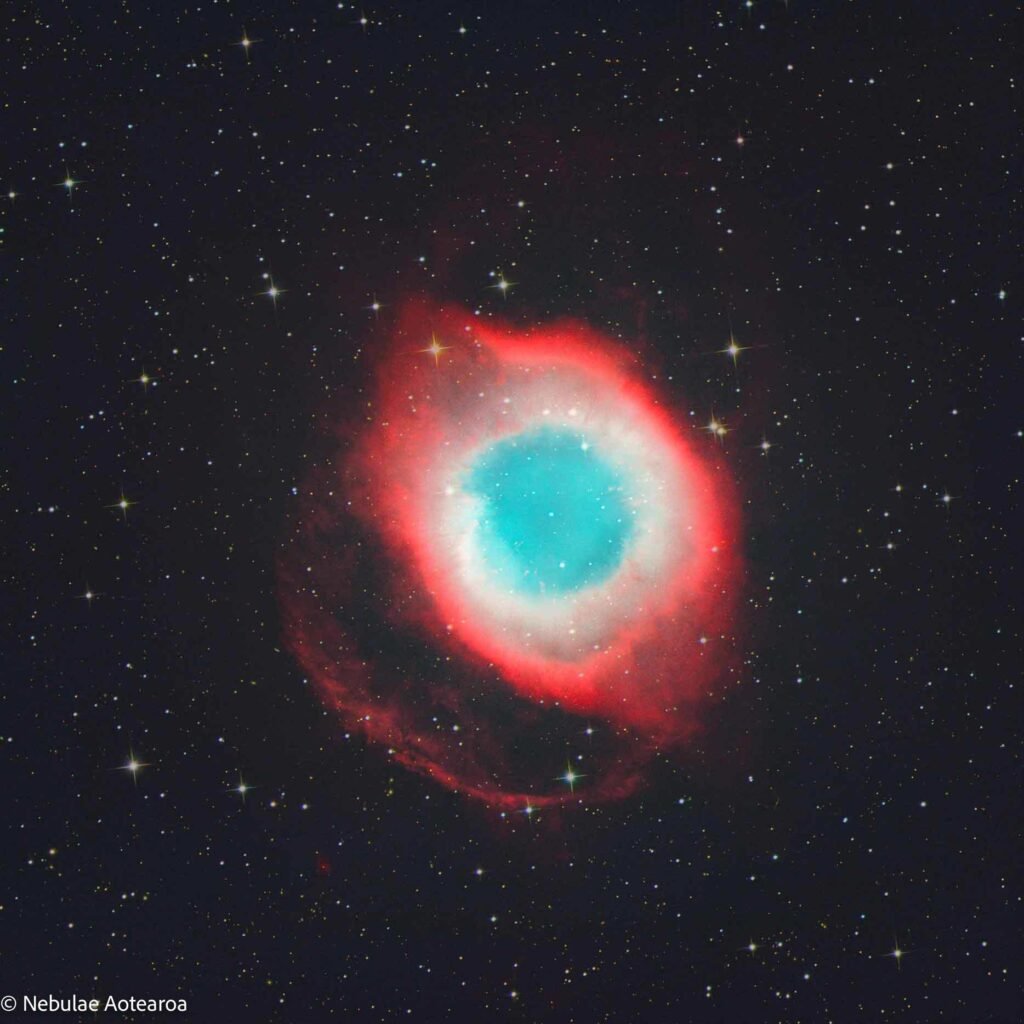
NGC 7293 — The Helix Nebula
RA/Dec (J2000): 22h 29m 38s, −20° 50′ 13″
Catalogue: NGC 7293, also known as the Helix Nebula.
Historical Overview
The Helix Nebula is one of the closest and best-known planetary nebulae. It was first recorded in the early 19th century, likely by Karl Ludwig Harding around 1824, and later catalogued by John Herschel in 1824 as part of his southern sky survey (Herschel 1864).
Because of its proximity and large apparent size, the Helix was an early subject of astrophotographic study. In the mid-20th century, its intricate filamentary structure was revealed in deep exposures (Curtis 1918; O’Dell 1963).
In modern times, Hubble and Spitzer observations have shown that the nebula consists of cometary knots — dense molecular clumps being evaporated by radiation from the central white dwarf (O’Dell et al. 2002). Its proximity makes it a benchmark planetary nebula for studying the fate of Sun-like stars.
Key Facts
- Distance: ~650 light-years (Benedict et al. 2009).
- Diameter: ~2.5 light-years.
- Age: ~10,600 years since ejection.
- Central star: Hot white dwarf (~120,000 K).
- Visibility: Very large (~25 arcmin), best seen in wide-field telescopes.
References
Benedict, G. F., et al. (2009). Astrometry with HST: Distances to Planetary Nebulae. AJ, 138, 1969.
Herschel, J. (1864). Catalogue of Nebulae and Clusters of Stars. Phil. Trans. Roy. Soc. London.
Curtis, H. D. (1918). Descriptions of 762 Nebulae and Clusters Photographed with the Crossley Reflector. Publ. Lick Obs.
O’Dell, C. R. (1963). The Structure of Planetary Nebulae. ApJ, 138, 293.
O’Dell, C. R., Balick, B., Hajian, A. R. et al. (2002). Cometary Knots in the Helix Nebula. AJ, 123, 3329.