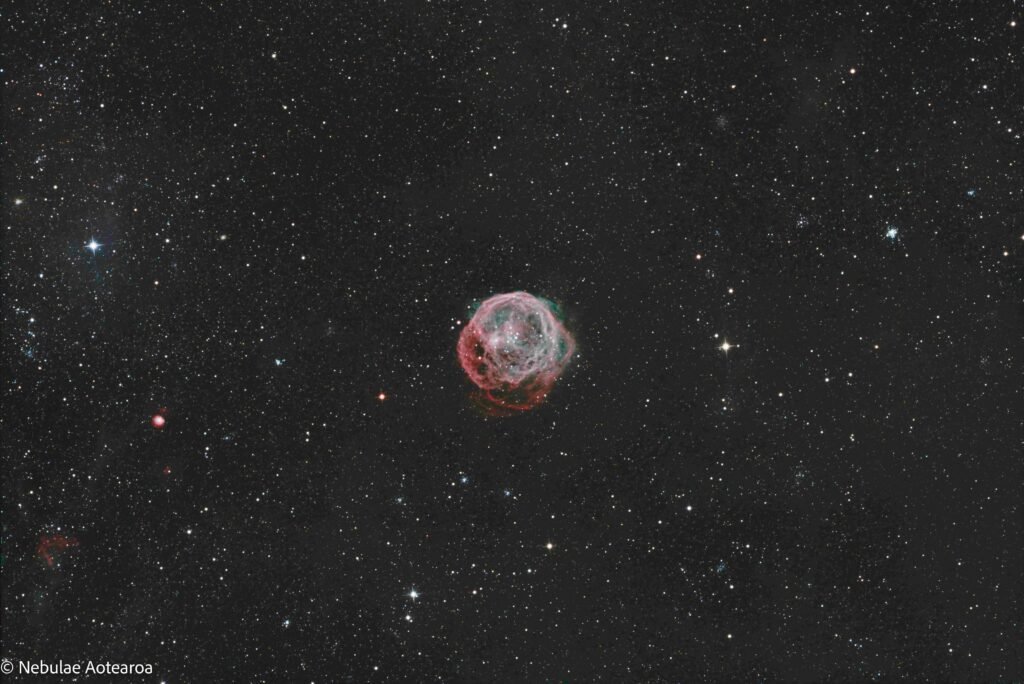
Henize 70 — Superbubble in the LMC
RA/Dec (J2000): 05h 30m 40s, −67° 25′ 20″
Constellation: Dorado (Large Magellanic Cloud)
Other designations: DEM L301, LMC superbubble
Historical Overview
Henize 70 is a large superbubble in the Large Magellanic Cloud (LMC), catalogued by Karl Henize in 1956 in his survey of LMC emission nebulae (Henize 1956).
Unlike small planetary or emission nebulae, superbubbles are created by the combined winds and supernova explosions of massive stars in OB associations. Henize 70 spans nearly 1,500 light-years, making it one of the largest superbubbles known in the LMC.
Radio and X-ray observations in the late 20th century revealed a hot, low-density cavity filled with ionized gas, surrounded by a cooler shell. This structure provides crucial insights into how massive stars shape galactic structure and trigger subsequent star formation (Rosado et al. 1996).
Today, Henize 70 is studied as a template for superbubble evolution in dwarf galaxies, with lessons applicable to early galactic environments.
Key Facts
- Type: Superbubble (giant H II region).
- Galaxy: Large Magellanic Cloud.
- Size: ~1,500 light-years.
- Scientific importance: Feedback processes from OB stars and supernovae.
References
Oey, M. S. & Massey, P. (1995). Feedback from Massive Stars in the LMC. ApJ, 452, 210.
Henize, K. G. (1956). Emission Nebulae in the Magellanic Clouds. ApJS, 2, 315.
Rosado, M. et al. (1996). Kinematics of Superbubbles in the LMC. A&A, 308, 588.