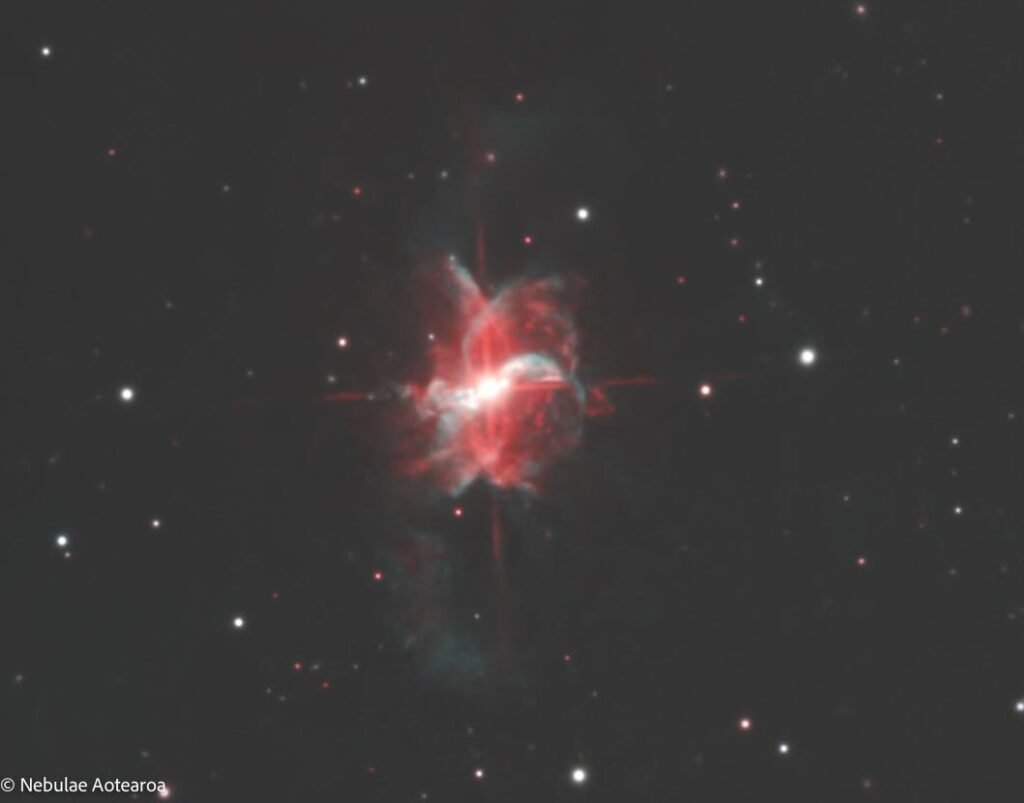
R Aquarii (R Aqr)
RA / Dec (J2000): ~ 23h 43m 49.46s, −15° 17′ 04.2″ (Wikipedia)
Other names / designations: HD 222800, HR 8992, BD −16° 6352, symbiotic variable star; nebula known also as Cederblad 211. (Wikipedia)
Historical Overview
- R Aqr is a well-known symbiotic binary star system, composed of a red giant (Mira-type variable) and a white dwarf. (Wikipedia)
- The red giant pulsates with period ~386-390 days, with large brightness changes, discovered in the early 19th century (Karl Ludwig Harding noted its variability in 1810-1811) (Wikipedia).
- The white dwarf accretes matter from the red giant’s expanded envelope and occasionally ejects gas, producing jets, loops, lobes, and a complex surrounding nebula. The nebula is often called Cederblad 211. (aavso.org)
- There have been inferred nova-like (or eruption) events in the past. Ancient astronomical records (Japanese or Korean) are sometimes associated with R Aqr; e.g., records around AD 930 and also an event in the 1700s are suggested to correspond to eruptions giving rise to outer rings. (irya.unam.mx)
Physical Properties & Structure
| Property | Value / Description |
| Distance: | ~ 650-710 light-years (~200-220 parsecs) (Center for Astrophysics) |
| Components: | Red giant (M Mira variable, spectral type ~M7IIIe) + white dwarf companion (hot, compact) (Wikipedia) |
| Luminosity / Temperature (for components): | Red giant: large radius (~430 × Sun), effective temperature ~2,800-3,000 K; white dwarf: much hotter (~60,000 K), much smaller and much lower luminosity except during accretion/outburst events. (Wikipedia) |
| Brightness / Variability: | Visual magnitude varies between ~+5.2 and ~+12.4 depending on pulsation phase and other factors. (Wikipedia) |
| Orbital period: | The binary orbit is ~44 years long; separation is small (tens of AU) with high eccentricity; the two stars have been resolved in high-resolution imaging (on the order of tens of milliarcseconds) (Wikipedia) |
| Nebula / Jets: | Complex nebula with outer hourglass / bipolar lobes, inner jets that are S-shaped, many knots and filaments; multiple eruption epochs. For example, kinematic studies suggest the large outer nebula is ~650 years old, inner features from ~125-290 years ago. (arXiv) |
| Expansion / Jet velocities: | Jet material blobs move rapidly; velocities from observations are hundreds to thousands km/s (optical, X-ray, radio), but values vary by emission region. (ESO) |
| Dust / Masers: | Detection of water (H₂O) and hydroxyl (OH) masers; presence of dust (silicates) in circumstellar environment; infrared emission shows dust features; mid-IR studies (e.g., SOFIA) have been used to study dust during eclipses of the red giant component. (arXiv) |
Recent Research Highlights
- A 2018 study by Liimets et al. (“New insights into the outflows from R Aquarii”) used long-term optical imaging (over 21 years) and integral field spectroscopy of [O III] emission to map velocity structure and expansion. It refined ages of nebular components: outer hourglass ≈ 650 years, inner features ≈ 125-290 years. (arXiv)
- X-ray observations (Chandra etc.) show a two‐sided jet, including shocks; also the inner regions show brightness variations and structure in the jets. (arXiv)
- Mid-infrared observations (SOFIA) tracked dust emission changes during eclipse of the red giant; in recent cycles, rising dust density noticed, changes in silicate emission features, and infrared grain sizes constrained; reveals that dust formation / emission responds to pulsation / eclipse cycles. (arXiv)
Key Facts Summary
- Type: Symbiotic binary star system (Mira variable + white dwarf) with complex surrounding nebula and jets.
- Distance: ~650-710 light-years (≈200-220 parsecs) from Earth.
- Variability period (Mira): ~386-390 days pulsation period.
- Orbital period (binary): ~44 years.
- Nebular age (outer structure): ≈ 650 years; inner jets / features younger (125-290 years).
- Max visual magnitude: ~5.2 (at peak) to ~12.4 (at minimum) depending on pulsation / light curve.
- Special features: Jets, bipolar hourglass lobes, multiple eruption rings (possible in AD 930, 1073, and 1770s), maser emission, dust envelope, variable obscuration/eclipse effects, knots, loops etc.
References
- UniverseGuide: R Aquarii summary. (Universe Guide)
- Liimets, T., Corradi, R. L. M., et al. (2018). “New insights into the outflows from R Aquarii.” A&A. (arXiv)
- “SOFIA/FORCAST Monitoring of the Dust Emission from R Aqr: Start of the Eclipse” (2021). (arXiv)
- Kellogg, E., Pedelty, J. A., Lyon, R. G., et al. (2001). “The X-ray R Aquarii: A Two-sided Jet and Central Source.” ApJ. (arXiv)
- “R Aquarii: a symbiotic star that resembles an active galaxy” (IRyA, UNAM news, Toalá et al.) (irya.unam.mx)
Harvard University has a video animation of the system:
https://chandra.harvard.edu/photo/2017/raqr/animations.html
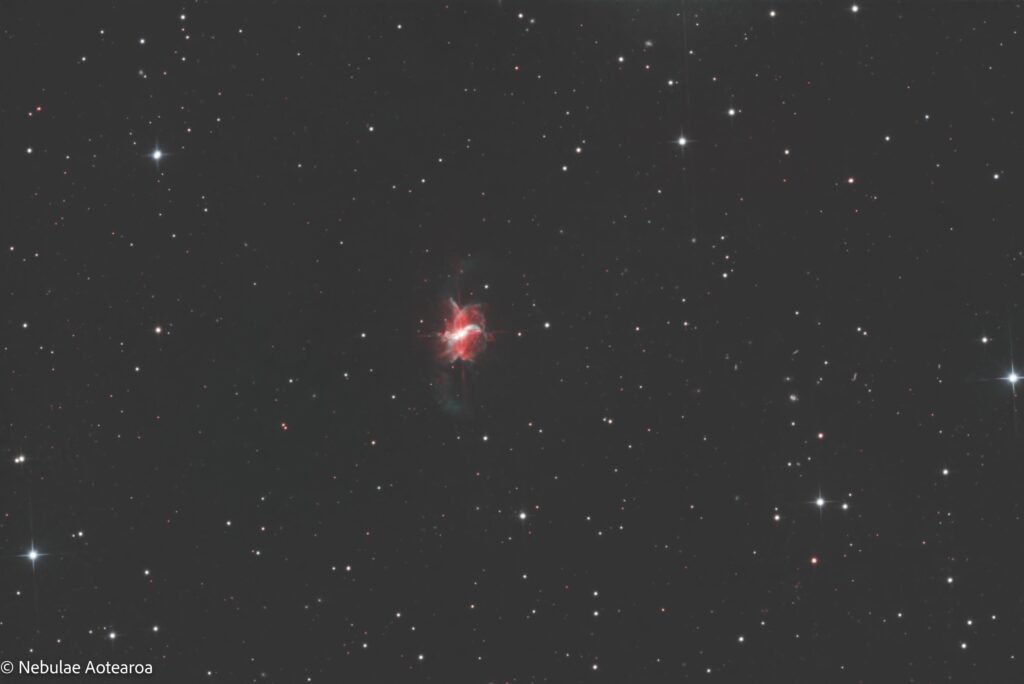
The images here are HOO images of that system processed in pixinsight from data that was collected on my Quattro F4 12” Newtonian at 1200mm on an EQ8RH-Pro mount with a QHY268M camera and filterwheel. The object is very small so the image below has been severely cropped