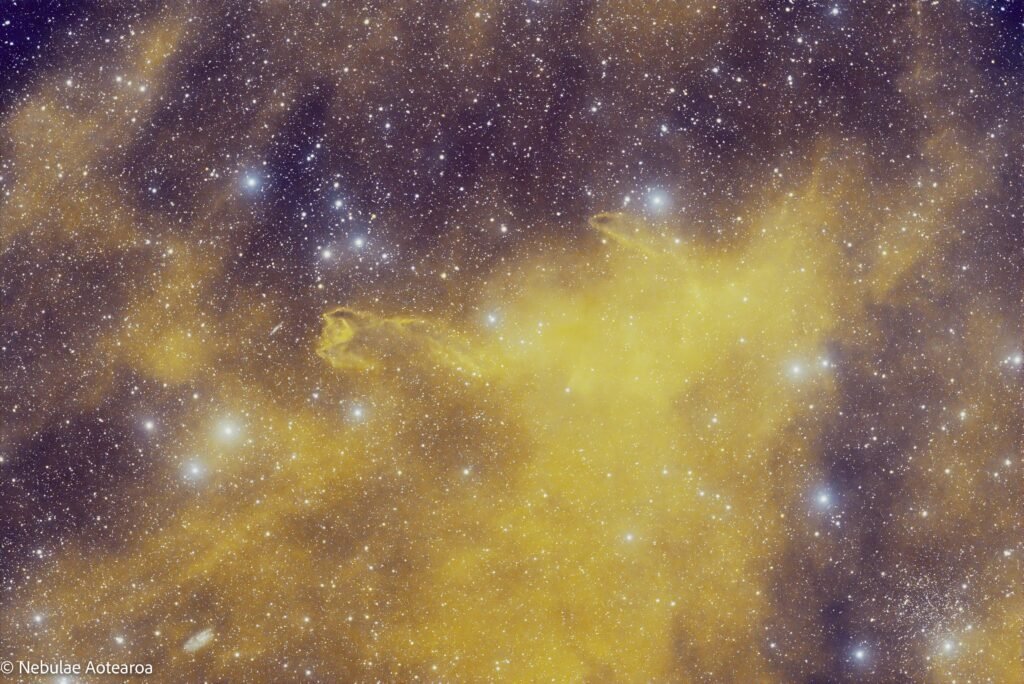
CG 4 — The “God’s Hand” Globule
RA/Dec (J2000): 07h 33m 00s, −46° 55′ 00″
Constellation: Puppis
Other designations: Cometary Globule 4
Historical Overview
CG 4 is one of several cometary globules first catalogued during the ESO/SERC Southern Sky Survey in the 1970s (Hawarden & Brand 1976). These globules are small, dense clouds of gas and dust, often shaped like comets with a “head” and a faint “tail.”
The nickname “God’s Hand” comes from astrophotography, where the bright-rimmed structure resembles a hand reaching into space. This shape is produced by erosion of the cloud by ultraviolet radiation from nearby massive stars, likely associated with the Vela Supernova Remnant.
CG 4 is about 1,300 light-years away, with its dense “head” about 1.5 light-years across, trailing a faint streamer some 8 light-years long. Inside the head, embedded stars are forming, revealed by infrared surveys with Spitzer.
Though faint visually, CG 4 has become a favorite astrophotography target due to its dramatic appearance.
Key Facts
- Type: Cometary globule.
- Distance: ~1,300 light-years.
- Size: ~8 light-years long.
- Scientific importance: Example of triggered star formation from supernova shocks and UV erosion.
References
Reach, W. T. et al. (2004). Spitzer Observations of Cometary Globules. ApJS, 154, 385.
Hawarden, T. G., & Brand, P. W. J. L. (1976). Southern Hemisphere Cometary Globules. MNRAS, 175, 19.
Reipurth, B. (1983). Cometary Globules and Star Formation. A&A, 117, 183.