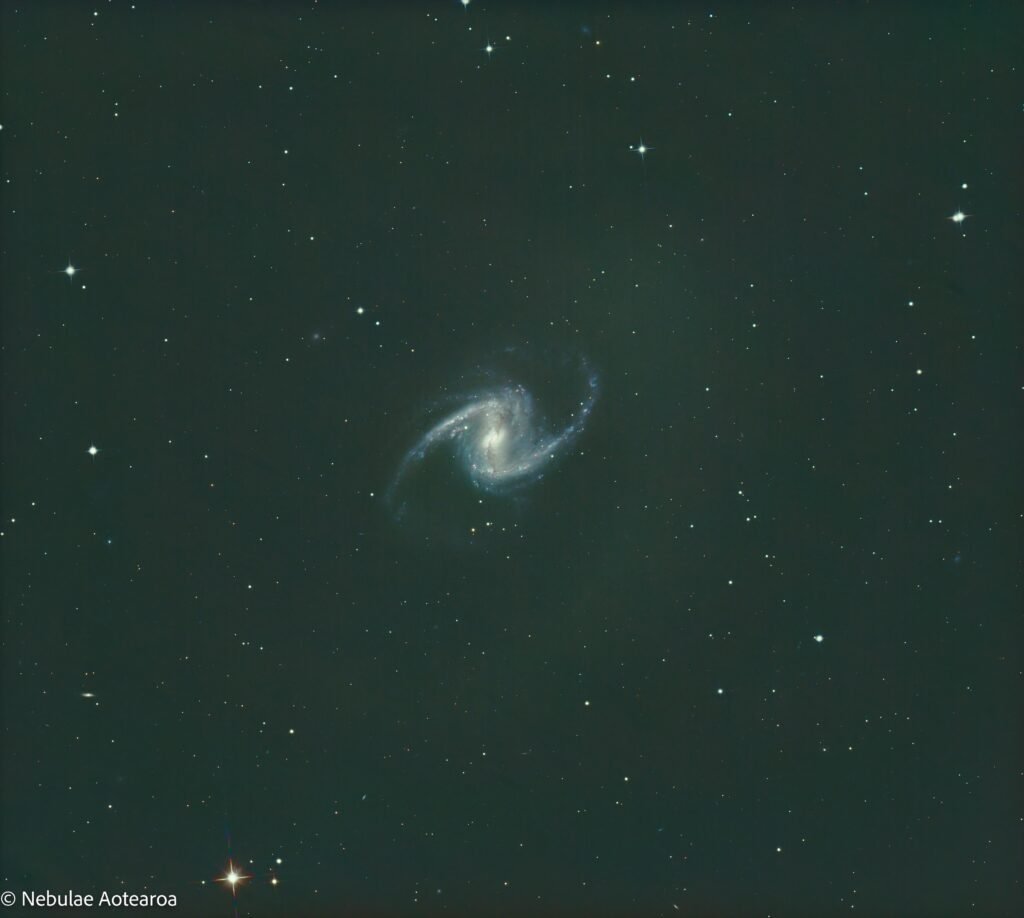
NGC 1365 — The Great Barred Spiral Galaxy
RA/Dec (J2000): 03h 33m 36s, −36° 08′ 25″
Constellation: Fornax
Other designations: Caldwell 74, The Great Barred Spiral
Historical Overview
NGC 1365 is one of the most magnificent barred spiral galaxies visible from Earth, notable for its pronounced central bar and sweeping spiral arms. It was discovered by Johann Friedrich Julius Schmidt in 1865 during his southern sky surveys from Athens (Schmidt 1865).
Early observers noted its elongated shape, but only with modern astrophotography and spectroscopy did the galaxy’s bar structure and active central region become apparent. NGC 1365 is classified as a Seyfert galaxy, hosting a supermassive black hole at its core, which fuels moderate nuclear activity (Lindblad 1999).
Its spiral arms contain numerous H II regions, star clusters, and dust lanes, making it a prime target for studies of bar-driven galactic dynamics. ALMA and Hubble observations have revealed gas inflows along the bar, feeding star formation in the nucleus.
Key Facts
- Type: Barred spiral galaxy (SBb).
- Distance: ~56 million light-years.
- Diameter: ~200,000 light-years.
- Scientific importance: Bar-driven star formation, Seyfert galaxy studies.
References
Sakamoto, K. et al. (2007). Molecular Gas Dynamics in NGC 1365. ApJ, 654, 782.
Schmidt, J. F. J. (1865). Observations of Southern Nebulae. Astronomische Nachrichten, 64, 145.
Lindblad, P. O. (1999). Bars and Spiral Structure in Galaxies. A&A, 136, 83.