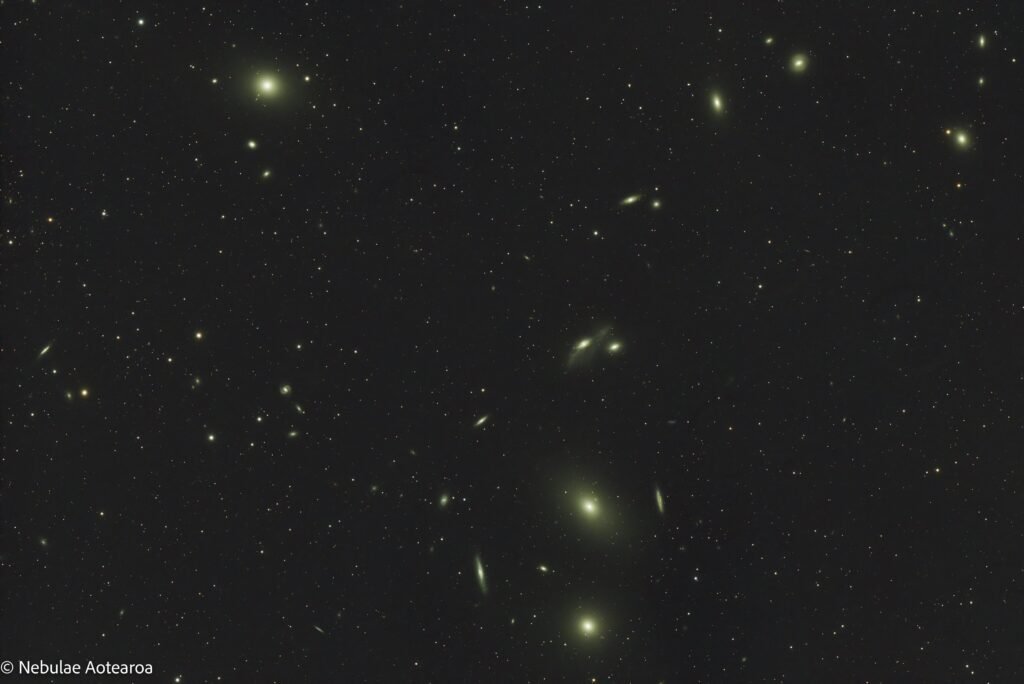
Markarian’s Chain — Virgo Cluster Galaxy Group
RA/Dec (J2000): Centered at ~12h 25m, +13° 00′
Constellation: Virgo
Other designations: Part of the Virgo Cluster.
Historical Overview
Markarian’s Chain is a striking stretch of galaxies forming a curved alignment within the Virgo Cluster. It was named after Armenian astrophysicist Benjamin Markarian, who studied active galaxies in the mid-20th century and noted this particular chain in 1961 (Markarian 1961).
The galaxies include M84 and M86, both giant ellipticals, along with NGC 4387, NGC 4388, NGC 4402, and others. Remarkably, several galaxies in the chain (M84, M86, NGC 4435, and NGC 4438) can be seen together in amateur telescopes.
Markarian’s Chain became famous in deep astrophotography and wide-field surveys because it visually suggests galaxies “flowing” through space. While not a true gravitational chain, the grouping reflects the core density of the Virgo Cluster, where galaxy interactions and mergers are common (Binggeli et al. 1985).
Key Facts
- Cluster membership: Virgo Cluster (~1,650 galaxies).
- Distance: ~55 million light-years.
- Notable galaxies: M84, M86, NGC 4435, NGC 4438.
- Scientific importance: Studies of galaxy clustering and dynamics in rich environments.
References
Tully, R. B. (1982). Nearby Galaxy Catalog. Cambridge University Press.
Markarian, B. E. (1961). Physical Properties of Galaxies with Ultraviolet Continuum. Astrofizika, 1, 24.
Binggeli, B., Sandage, A., & Tammann, G. A. (1985). The Virgo Cluster Catalog. AJ, 90, 1681.