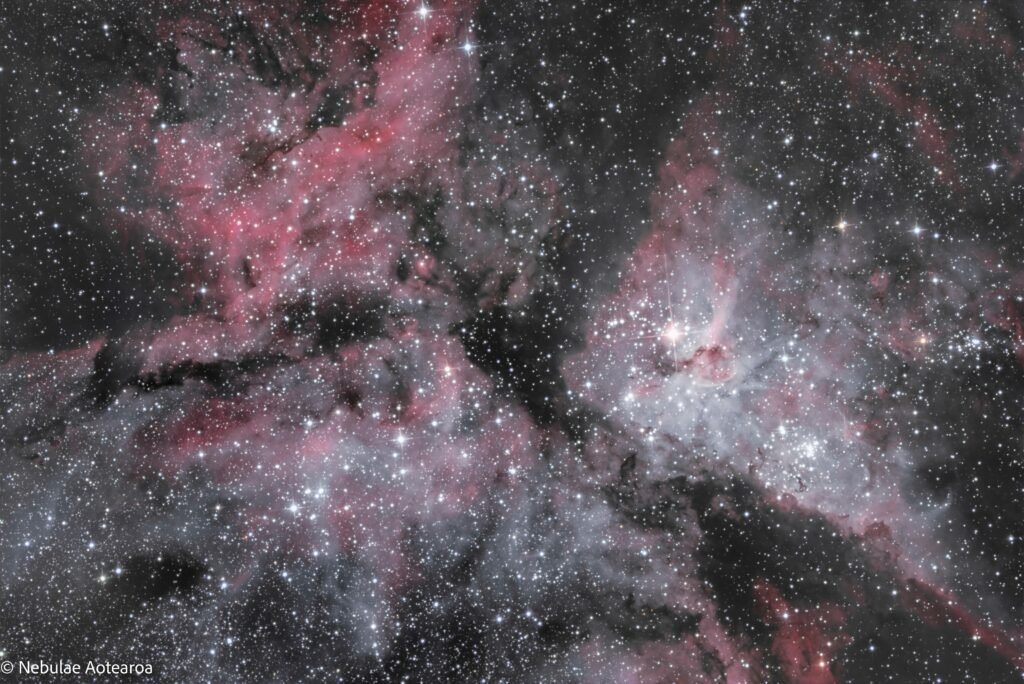
The Carina Nebula — NGC 3372 (“Great Carina Nebula”)
RA/Dec (J2000): approximately 10h 44m 00s, −59° 52′ 00″ Wikipedia+1
Catalogue / Other Names: NGC 3372, Eta Carinae Nebula, Caldwell 92; contains open clusters such as Trumpler 14, Trumpler 16, Collinder 228 etc. constellation-guide.com+2Wikipedia+2
Historical Overview
- The Carina Nebula was discovered by Nicolas-Louis de Lacaille on 25 January 1752 during his observing expedition at the Cape of Good Hope. Wikipedia+2constellation-guide.com+2
- Lacaille entered it in his southern catalogue under designations that corresponded to the nebula’s bright emission region (catalogued as Lac III.5 and Lac III.6), describing it as a vast region of small stars and nebulosity. constellation-guide.com
- Later observers including John Herschel and James Dunlop studied the region, recognizing the bright clusters, massive stars, and complex structures of gas and dust. Herschel’s surveys described features like the Keyhole Nebula, the Homunculus, and others. constellation-guide.com+2Wikipedia+2
Physical / Scientific Highlights
- The Carina Nebula is a large, bright diffuse emission nebula in the Carina-Sagittarius arm of the Milky Way. Wikipedia+2European Space Agency+2
- Distance: ~8,500 light-years (≈ 2,600 parsecs). Wikipedia+2European Space Agency+2
- Angular size: about 120 × 120 arc-minutes (i.e. ~2° × 2°) on the sky. Wikipedia+2The Planets+2
- Physical size: Spans on the order of 200–230 light-years across. European Space Agency+2ThoughtCo+2
Key Components & Notable Objects
- Eta Carinae, a luminous blue variable (LBV) star system, one of the most massive and luminous stars known, with past eruptions (notably the “Great Eruption” of the 19th century) that shaped the Homunculus Nebula around it. Wikipedia+1
- Open clusters: Trumpler 14, Trumpler 16, Collinder 228, etc., containing many hot O-type and Wolf-Rayet stars. constellation-guide.com+2Wikipedia+2
- Numerous bright and dark nebular structures: Keyhole Nebula region, Mystic Mountain pillars, Bok globules, dust pillars being eroded by radiation from massive stars. constellation-guide.com+2NASA Science+2
Modern Science & Research
- The Carina Nebula is considered a “laboratory” for studying star formation, especially feedback processes, i.e. how massive stars (UV radiation, stellar winds) both trigger and suppress star formation in surrounding gas. arXiv+2universe-of-learning.org+2
- Surveys in X-ray, infrared, optical have catalogued many young stars (pre-main sequence), embedded clusters, and sources obscured by dust. For example, Chandra observations found ~450 X-ray sources in certain parts including Trumpler 16 and Trumpler 14, many of them young stars affected by extinction. arXiv
- The massive stellar population (≈ 65 O-type stars + 3 WNH stars) produces extremely large ionizing photon flux and strong mechanical feedback; historically when Eta Carinae was on the main sequence, the nebula was even more intense in its output, exceeding the Orion Nebula by ~150× in ionizing flux in that era. arXiv+1
Key Facts Summary
- Distance: ~8,500 light-years from Earth. Wikipedia
- Apparent magnitude: ~ +1.0 in V-band (very bright nebulosity) as a whole when integrated. Wikipedia+1
- Angular size: ~120′ × 120′ (≈ 2° × 2°) on the sky. Wikipedia+1
- Physical size: ~200–230 light-years across. European Space Agency+1
- Massive stars: Includes Eta Carinae (LBV), Wolf-Rayet stars, O2 supergiants. Wikipedia+1
- Clusters: Trumpler 14 and Trumpler 16 are among youngest clusters; also Collinder clusters. constellation-guide.com
- Scientific importance: Feedback, triggered star formation, extreme star-forming environments visible across multiple wavelengths; pillar/dust structures; one of the best studied massive nebulae.
References
“X-ray Emitting Young Stars in the Carina Nebula” (Sanchawala et al. 2006). arXiv
Lacaille, N.-L. (1752). Discovery from the Cape of Good Hope. & “Coelum Australe Stelliferum”. Wikipedia+1
Nathan Smith, Kate J. Brooks (2008). The Carina Nebula: A Laboratory for Feedback and Triggered Star Formation. arXiv:0809.5081. arXiv
“A Census of the Carina Nebula. I: Cumulative Energy Input from Massive Stars” (Smith 2006). arXiv