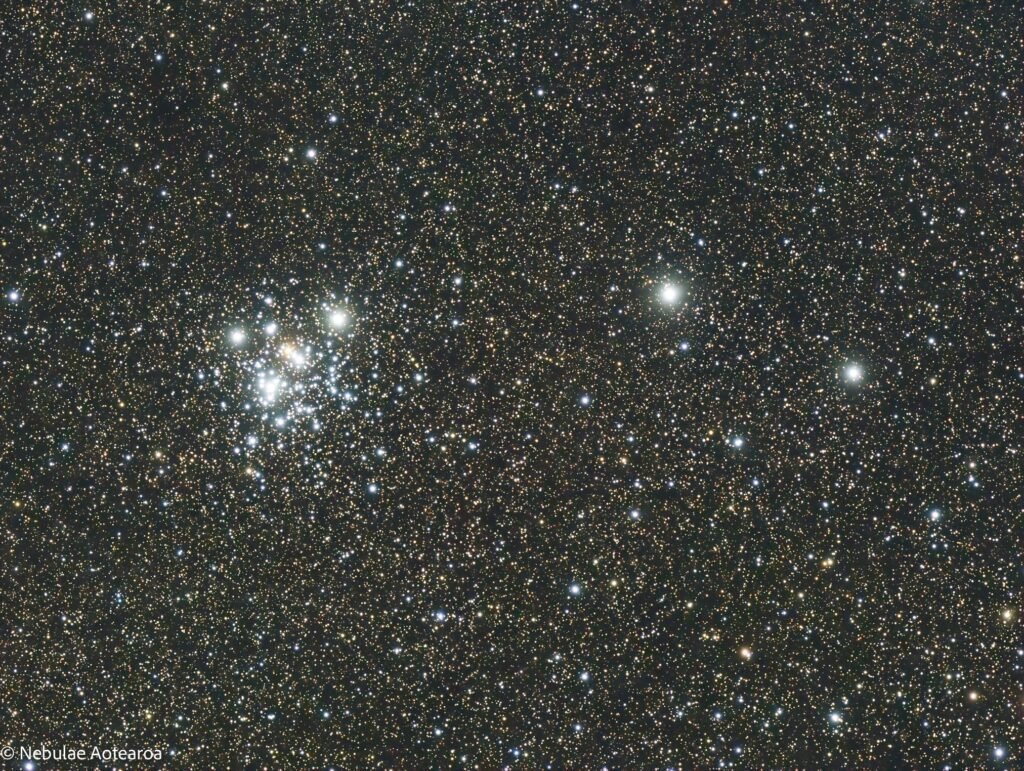
NGC 4755 — The Jewel Box Cluster
RA/Dec (J2000): 12h 53m 42s, −60° 22′ 00″
Constellation: Crux
Other designations: Caldwell 94, Kappa Crucis Cluster
Historical Overview
NGC 4755, popularly called the Jewel Box Cluster, is one of the most famous and colorful open clusters in the southern sky.
- Discovery: First recorded by Nicolas-Louis de Lacaille in 1751–1752 during his expedition to the Cape of Good Hope, where he catalogued thousands of southern stars and nebulae (Lacaille 1755). He described it as “a casket of variously colored precious stones,” inspiring its enduring nickname.
- John Herschel later studied it extensively during his Cape surveys (1830s), noting its striking mix of bright red supergiants and brilliant blue stars (Herschel 1847).
- The cluster was later designated Caldwell 94 in Patrick Moore’s Caldwell Catalogue, highlighting its appeal to amateur observers.
Throughout the 19th and 20th centuries, NGC 4755 became an iconic southern object, frequently cited in observing handbooks as one of the sky’s most beautiful star clusters.
Key Facts
- Type: Open star cluster.
- Distance: ~6,440 light-years (1,975 parsecs).
- Apparent magnitude: ~4.2 (visible to the naked eye in dark skies).
- Apparent size: ~10 arcminutes across.
- Age: ~14 million years (a very young cluster).
- Notable stars:
- Kappa Crucis (HD 111973): A bright red supergiant (~mag 5.9), the standout “ruby” of the cluster.
- Several brilliant blue supergiants, providing dramatic color contrast.
- Scientific importance: Classic laboratory for studying the early evolution of massive stars; its mix of red and blue supergiants makes it a key reference for stellar astrophysics.
References
Turner, D. G. (1982). The Jewel Box Cluster (NGC 4755) as a Stellar Laboratory. PASP, 94, 100.
Lacaille, N. L. de (1755). Catalogue des Étoiles Australes. Paris.
Herschel, J. F. W. (1847). Results of Astronomical Observations Made at the Cape of Good Hope. London.
Mermilliod, J. C. (1981). Open Cluster Data and Ages. A&A, 97, 235.