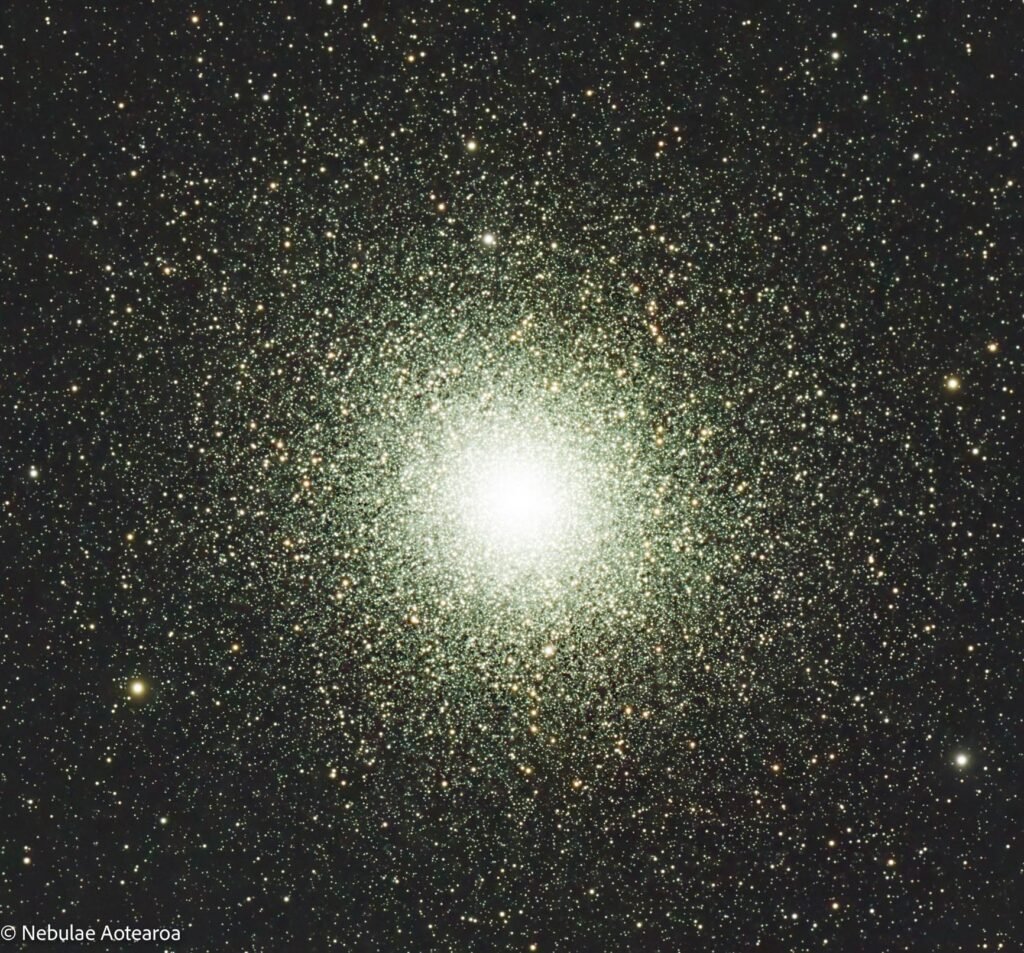
NGC 104 — 47 Tucanae
RA/Dec (J2000): 00h 24m 05s, −72° 04′ 52″
Constellation: Tucana
Other designations: Caldwell 106, 47 Tuc
Historical Overview
NGC 104, better known as 47 Tucanae, is the second-brightest globular cluster in the night sky after Omega Centauri. It was first catalogued by Nicolas-Louis de Lacaille in 1751–52 during his expedition to the Cape of Good Hope (Lacaille 1755).
Initially described as a “nebulous star,” its true nature as a globular cluster wasn’t recognized until the telescopic studies of James Dunlop (1826) and John Herschel (1834), who resolved it into countless stars.
47 Tuc is about 13 billion years old, containing several million stars within a radius of about 120 light-years. It is particularly rich in millisecond pulsars and exotic binaries, discovered through X-ray and radio surveys (Camilo et al. 2000).
The cluster is located close to the Small Magellanic Cloud (SMC), making it a favorite southern sky showpiece for both amateurs and professionals.
Key Facts
- Type: Globular cluster.
- Distance: ~13,000 light-years.
- Age: ~13 billion years.
- Stars: Millions, including red giants, blue stragglers, and millisecond pulsars.
- Historical significance: One of the key southern discoveries of Lacaille.
References
Camilo, F. et al. (2000). Millisecond Pulsars in 47 Tucanae. ApJ, 535, 975.
Lacaille, N.-L. (1755). Catalogue des Étoiles Australes. Paris.
Herschel, J. (1834). Observations of the Southern Hemisphere. Royal Society Transactions.