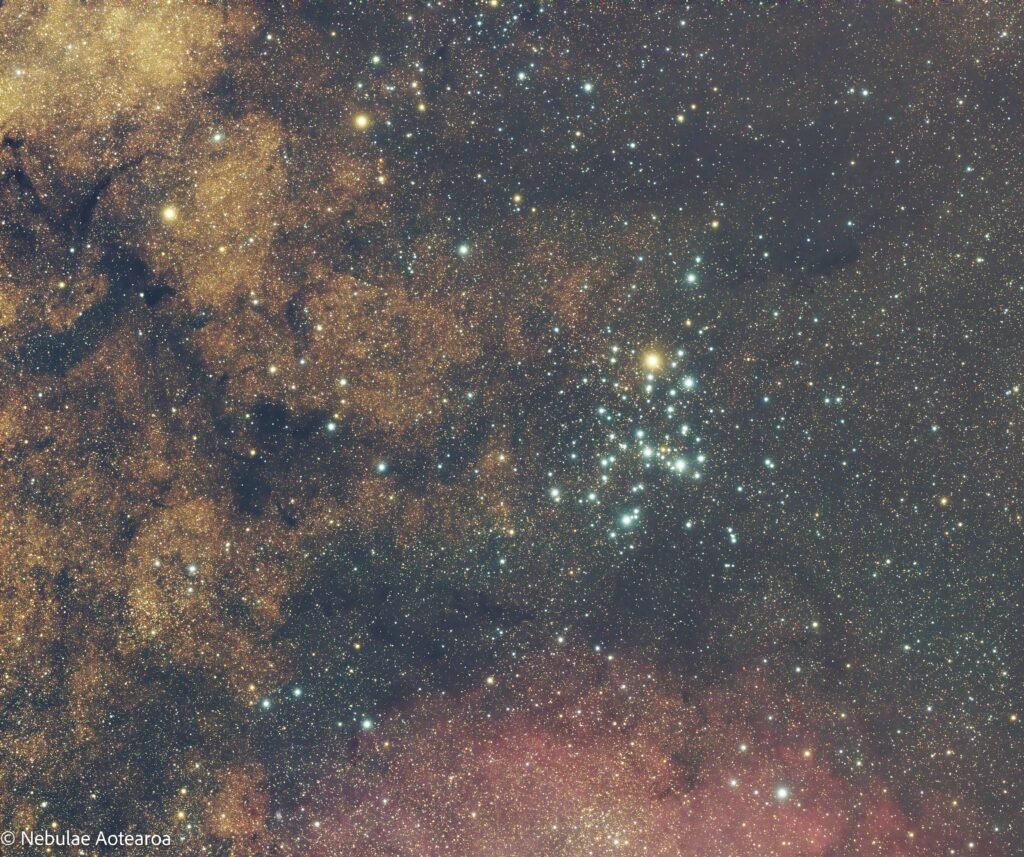
M6 — The Butterfly Cluster (NGC 6405)
RA / Dec (J2000): approximately 17h 40m 20s, −32° 13′ (Go-Astronomy.com)
Constellation: Scorpius (Wikipedia)
Historical Overview
- The Butterfly Cluster’s existence was first recorded (visually) before 1654 by Giovanni Battista Hodierna. (deepskycorner.ch)
- It was likely known (but not clearly identified as a cluster) even earlier; some historians suggest Ptolemy might have observed it as part of the “nebulous ones” near M7 in his star catalog. (deepskycorner.ch)
- The first definitive recognition as a cluster is credited to Philippe Loys de Chéseaux in 1746. (deepskycorner.ch)
- Nicolas-Louis de Lacaille catalogued it in his 1751-52 survey as Lac III.12, describing its appearance. (Universe Today)
- Charles Messier added it to his catalog on 23 May 1764 as M6. (Universe Today)
Physical Properties & Key Facts
| Property | Value / Description |
| Distance from Earth: | ~ 1,600 light-years (≈ 490-500 parsecs) (Go-Astronomy.com) |
| Apparent magnitude (V): | ~ +4.2 — bright enough to be seen with the naked eye under good conditions (Wikipedia) |
| Apparent size: | ~ 25 arcminutes across for the main bright region; fainter structure may extend more (Go-Astronomy.com) |
| Physical size: | The core “butterfly wing” area spans ≈ 9 light-years; full cluster diameter ~ 20 light-years across (deepskycorner.ch) |
| Age: | ~ 90-100 million years (Wikipedia) |
| Stellar population: | Mostly hot blue B-type main sequence stars; brightest star is BM Scorpii, a K-type (orange/red) giant, semi-regular variable, magnitude ~5.5 to ~7.0 (deepskycorner.ch) |
| Metallicity: | Slightly above solar, with [Fe/H] ~ +0.07 ± 0.03 dex for its F-type stars in a 2015 study (Tolgahan Kılıçoğlu et al.) (arXiv) |
| Cluster membership / density: | ~80 known brighter members in one survey; overall membership could be higher (including fainter stars) (deepskycorner.ch) |
Scientific Interest / Recent Research
- A study by Kılıçoğlu et al. (2015) analysed the chemical abundances of intermediate-mass stars (late B, A, F types) within M6. They found some variation among B and A types (likely due to rotation / diffusion effects), and a mean metallicity slightly above solar. (arXiv)
- The presence of BM Scorpii (a variable giant) adds color contrast and serves as a useful calibration / test object in studying cluster evolution and stellar variability. (deepskycorner.ch)
- Because M6 is relatively young, but not extremely young (≈ 100 Myr), it occupies a useful age range for studies of stars just evolving off the main sequence, the development of giant stars, and how abundances and rotation affect stellar spectra in B-/A-type stars.
Visibility & Observational Notes
- Good target for binoculars or small telescopes; the “butterfly shape” is especially noticeable in wide fields with modest aperture and dark skies. (deepskycorner.ch)
- Located near the “tail” end of Scorpius; easier to view during summer months in the southern hemisphere, though visible from mid-northern latitudes as well. (Universe Today)
- Its brightest star (BM Scorpii) exhibits large color contrast relative to the bluer cluster members, which is attractive in astrophotography.
References
Kılıçoğlu, T., Monier, R., Richer, J., Fossati, L., Albayrak, B. (2015). Chemical composition of intermediate mass stars members of the M6 (NGC 6405) open cluster. arXiv preprint. (arXiv)
“Butterfly Cluster (Messier 6), Open cluster in Scorpius.” Wikipedia. (Wikipedia)
“Butterfly Cluster (Messier 6)” – DeepSkyCorner detailed entry. (deepskycorner.ch)
“Messier 6 — The Butterfly Cluster,” Universe Today. (Universe Today)