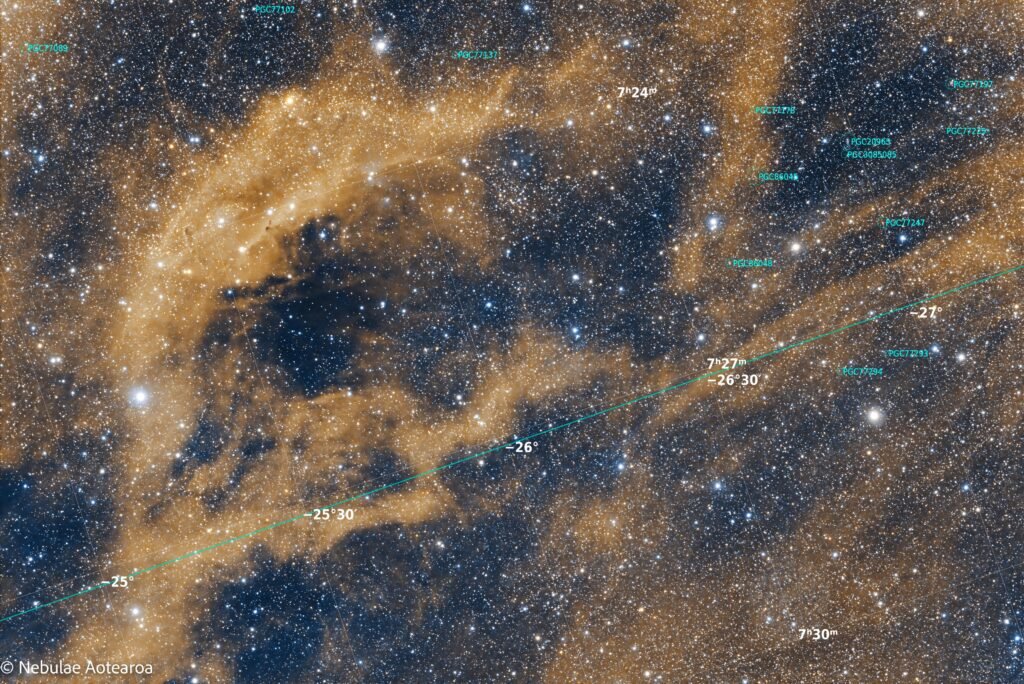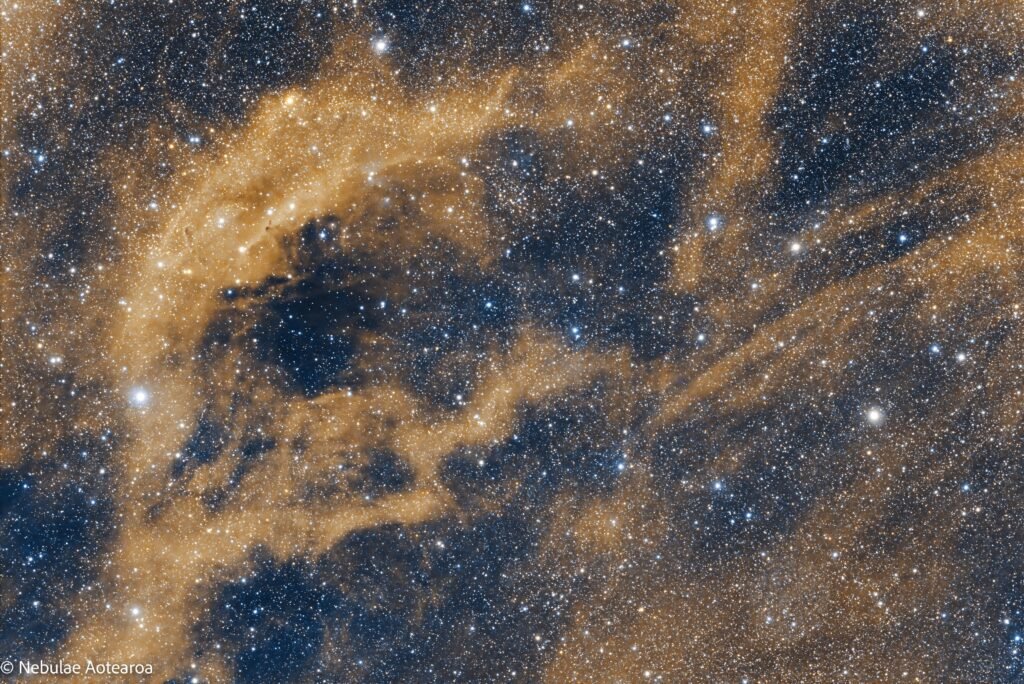
Sh2-310 (Sharpless 310) — “Gum 8” H II Region
The image above image was captured using a Skywatcher Esprit 100ED APO telescope (550mm focal length at F5.5) on an EQ6r-Pro mount and a ZWO ASI2600 MC duo camera with a Optolong L-eXtreme dual narrow band filter. The data was processed in pixinsight into the above HOO image.
RA / Dec (J2000): ~ 07h 19m, −24° 45′ (approximatly, as per wide-field imaging centroids) (Deep-sky Imaging / Galaxymap)
Description & Environment
- Sh2-310 is a large H II (ionized hydrogen) emission region, catalogued in the Sharpless survey (Sharpless 1959). It is also known as Gum 8 in the Gum catalogue of southern nebulae. (Wikipedia: Sh2-310; Galaxymap)
- It is associated with the open cluster NGC 2362, which is physically embedded in or near the Sh2-310 complex; many of the hot stars of NGC 2362 contribute to the ionization of Sh2-310. Other contributing stars include Tau Canis Majoris, UW Canis Majoris, and HD 58011. (Wikipedia: VY Canis Majoris mention; Galaxymap)
Physical Properties & Measurements
| Property | Estimate / Description |
| Distance | ~1,500 parsecs (~4,900 light-years) is the most commonly quoted value. Some estimates go higher. (Wikipedia (Italian); Deep-sky Imaging) |
| Size / Angular extent | The nebula spans over 4° on the sky according to Italian-language sources; imaging suggests the bright arch of nebulosity is ~1.2° in some frames. So it appears very large in angular size but much of that is faint, diffuse emission. (Deep-sky Imaging; Wiki-IT) |
| Physical size | Using ~1.5 kpc distance plus angular extent, physical size is on the order of ~200 pc across in total for the extended diffuse region. (Galaxymap; Wiki-IT) |
| Morphology | The structure includes a central cavity or bubble, formed likely by stellar winds and UV radiation from its massive stars clearing out gas. There is an arch of bright nebulosity; faint reflection nebulosity is visible on some edges. Some peripheral dark/dusty regions and molecular clouds still show star formation (e.g. LDN 1660, LDN 1664) with infrared sources and masers. (Deep-sky Imaging; Wiki-IT) |
| Age / Evolution | Sh2-310 is relatively evolved: most of its gas has been ionized or cleared out in central regions; star formation is now mostly happening in peripheral/dense clumps rather than throughout. The cluster NGC 2362 is old enough that many of its stars are already on the main sequence, and the nebula’s central cavity is well developed. (Wiki-IT) |
Observational / Practical Notes
- Because of its size and relatively low surface brightness, Sh2-310 is not very prominent in small telescopes or with broadband filters. Long-exposure narrowband (Hα, maybe also some [S II]) imaging works best. (Deep-sky Imaging)
- Best observed from southern latitudes, especially between December and April, when its RA/Dec is favourable in the evening sky. From northern latitudes it stays low and can be hindered by atmospheric extinction. (Wiki-IT)
Scientific / Astrophysical Importance
- Sh2-310 is a good example of a large H II region in a late stage of evolution, where the brightest massive stars have already formed and cleared out much of the central gas, leaving peripheries still forming stars.
- Studies of Sh2-310 help understand feedback from massive stars (UV, stellar winds) in shaping nebulae and molecular clouds.
- It is physically associated with NGC 2362, which is often used to calibrate age and distance for this region; together, they offer clues about how clusters and nebulae evolve side by side.
- The presence of infrared sources, dark clouds, and masers in its outskirts still show that star formation continues, albeit not as strongly as in younger, denser H II regions.
Sources & References
- “Sh2-310 — Galaxymap” entry. ([Galaxymap])
- Italian Wikipedia: Sh2-310 (“Sh2-310 (conosciuta come Gum 8) … circa 1500 parsec … estesa per oltre 200 parsec …”) (Wiki-IT)
- Deep-sky Imaging blog: “Sh2-310: Another hidden southern gem” by Charles Bracken, Nov 2023 (Deep-sky Imaging)