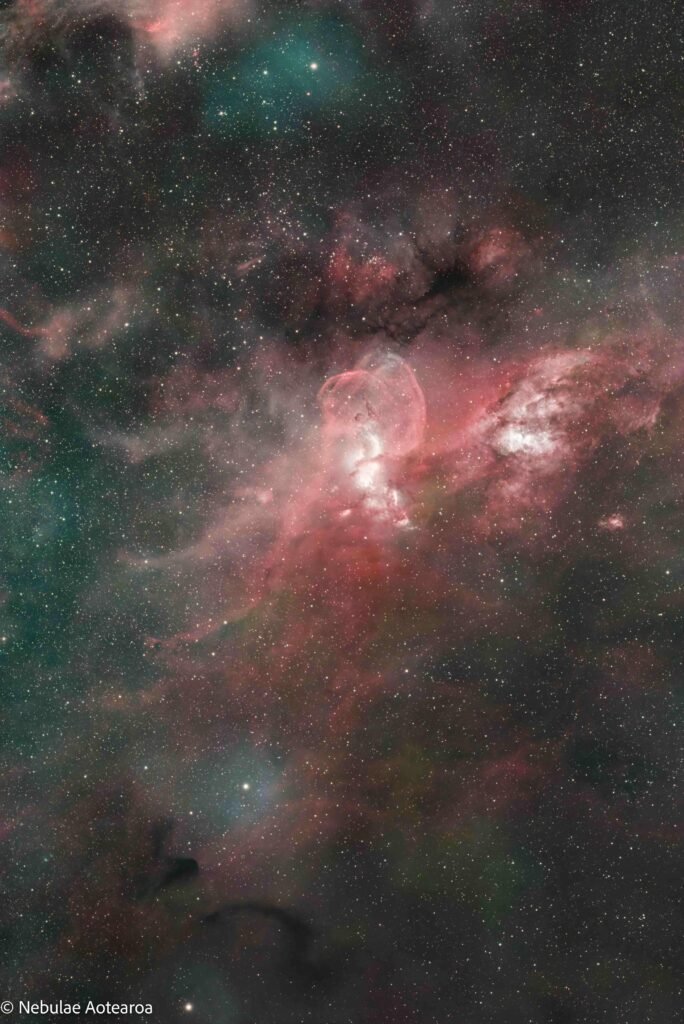
NGC 3576 — The “Statue of Liberty” Nebula
RA 11h 11m 31.7s, Dec −61° 21′ 47″ (J2000)
NGC 3576 is a large, bright emission nebula in the Carina constellation, roughly 2.4-3.0 kpc (~8,000-10,000 ly) away. Discovered by John Herschel in 1834, it was catalogued in multiple NGC entries before being understood as one coherent region. Its nickname “Statue of Liberty Nebula” comes from a shape in the central emission that evokes that figure in some narrowband images.
This nebula is among the most luminous H II regions in the southern sky, featuring embedded clusters of massive young stars, strong infrared emission, filaments, dark dust lanes, and evidence of feedback from massive stars. Spectroscopic surveys have mapped its chemical abundances, while radio and molecular observations reveal temperature and velocity gradients, dense clumps, and ongoing star formation.
References
ATNF News / Purcell, C. (2007). “The environment of the giant HII region NGC 3576.” (CSIRO Astronomy and Space Science)
“NGC 3576,” Wikipedia entry. (Wikipedia)
De Pree, C. G., Nysewander, M., & Goss, W. M. (1999). “NGC 3576 and NGC 3603: Two Luminous Southern HII Regions …” arXiv/ATCA observations. (arXiv)
Garcia-Rojas, J., Esteban, C., Peimbert, M., et al. (2004). “Chemical abundances of the Galactic H II region NGC 3576 …” VLT UVES Spectrophotometry. (arXiv)