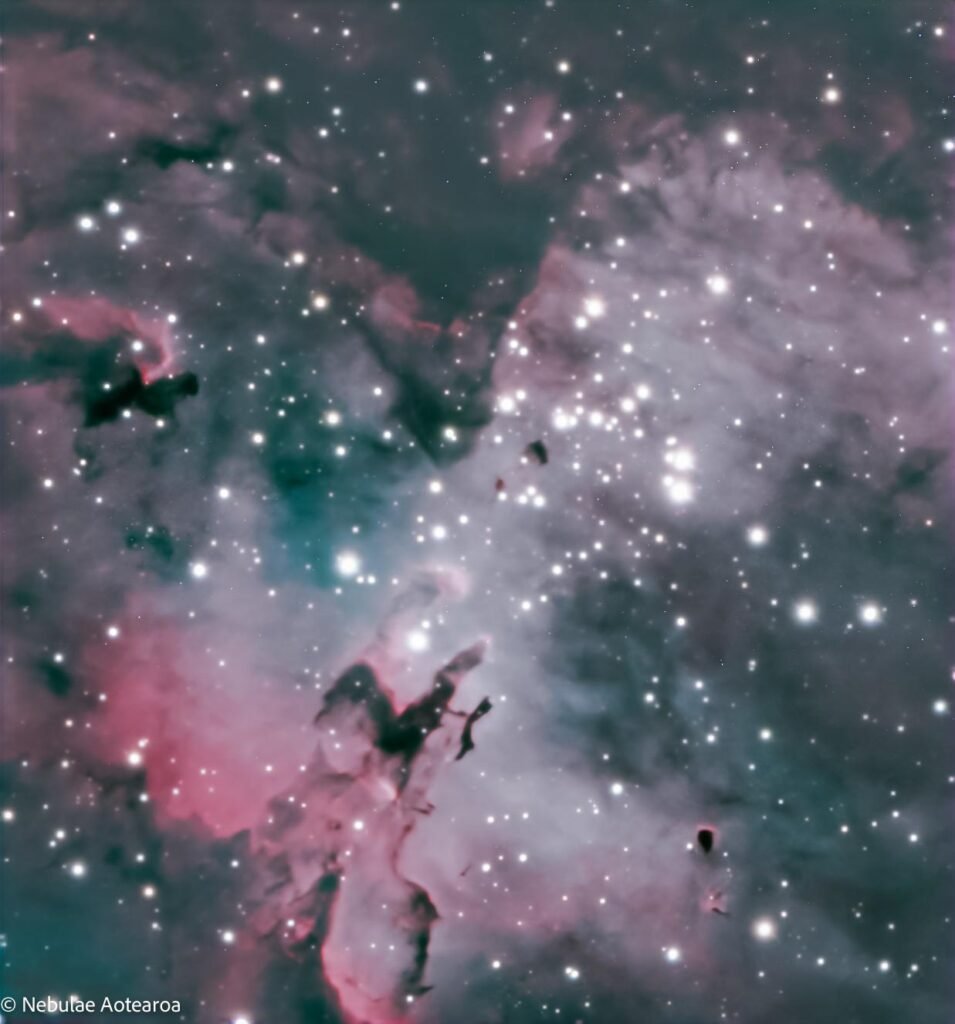
M16 — The Eagle Nebula
RA/Dec (J2000): 18h 18m 48s, −13° 47′ 00″
Constellation: Serpens
Other designations: NGC 6611 (cluster), IC 4703 (nebula), Caldwell 20
Historical Overview
The Eagle Nebula (M16) is one of the most famous star-forming regions in the Milky Way. The central star cluster, NGC 6611, was first discovered by Jean-Philippe Loys de Chéseaux in 1745–46, later independently noted by Charles Messier in 1764 (Messier 1764).
The nebula itself, IC 4703, was identified in the 19th century. Early photography by Edward Barnard in the 1890s showed its dark dust lanes. However, M16 achieved worldwide fame after the Hubble Space Telescope’s 1995 “Pillars of Creation” image, which revealed towering columns of gas and dust sculpted by stellar radiation (Hester et al. 1996).
The Eagle Nebula is part of a giant molecular cloud complex, about 7,000 light-years away. It is actively forming stars, particularly within dense Bok globules inside the pillars. The central cluster, NGC 6611, contains hot O- and B-type stars only a few million years old.
Key Facts
- Type: Emission nebula and star cluster.
- Distance: ~7,000 light-years.
- Notable feature: “Pillars of Creation” columns.
- Scientific importance: One of the most iconic examples of triggered star formation.
References
Hester, J. J. et al. (1996). HST Imaging of the Pillars of Creation. AJ, 111, 2349.
Messier, C. (1764). Catalogue des Nébuleuses et des Amas d’Étoiles. Paris.
Barnard, E. E. (1895). Photographs of the Eagle Nebula. Astronomical Society Publications.