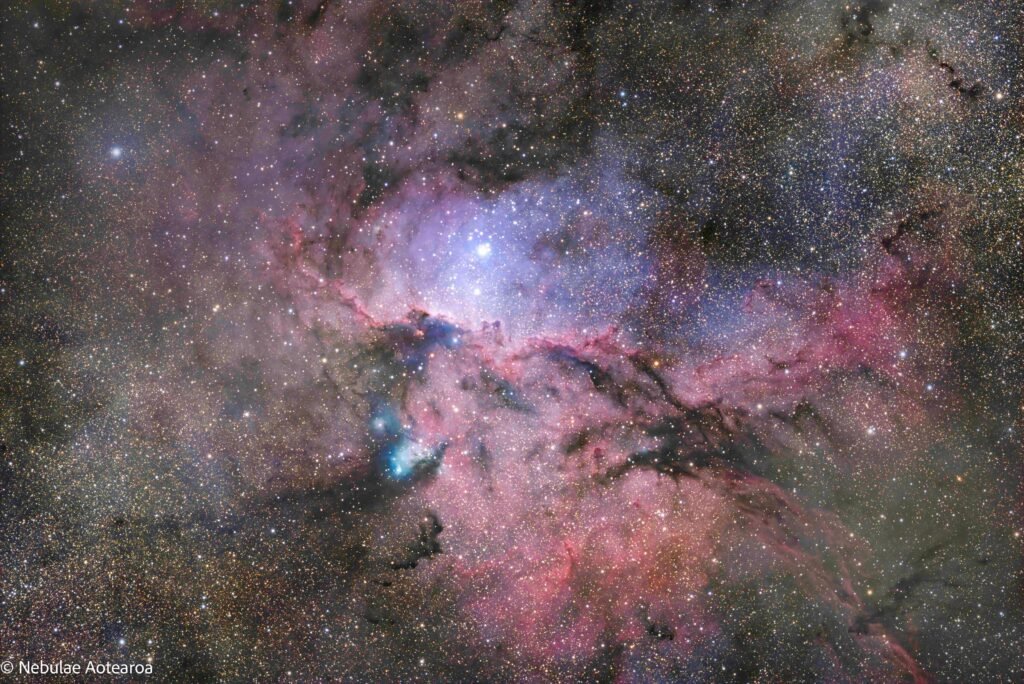
The Fighting Dragons of Ara — NGC 6188
RA/Dec (J2000): 16h 40m 21s, −48° 42′ (≈) Astrodrudis+3NOIRLab+3Wikipedia+3
Constellation: Ara
Historical & Scientific Overview
- Nature: NGC 6188 is an emission nebula / star-forming region; its gas is ionized by nearby young, hot stars (primarily from the open cluster NGC 6193). NOIRLab+3Astrodrudis+3Galactic Hunter+3
- “Fighting Dragons” nickname: The nebula’s bright center region has features that resemble two dragon heads facing each other; that imagery has driven the popular nickname “Fighting Dragons of Ara.” Galactic Hunter+2Wikipedia+2
- Discovery / Catalog Info: It’s catalogued as NGC 6188; it was observed by John Herschel during his southern sky surveys. Galactic Hunter+1
Key Facts
| Property | Value / Description |
|---|---|
| Distance: | ~4,000 light-years from Earth. Galactic Hunter+3Wikipedia+3Astrodrudis+3 |
| Size (apparent): | Estimates vary: some sources say ~20′ × 12′, others for larger wide-field mosaics as much as 96′ × 24′. Astrodrudis+2Astrodrudis+2 |
| Magnitude: | Around +5.2 (for bright parts / integrated) in some imaging sources. Astrodrudis+1 |
| Components / Excitation: | Ionization is driven by young OB stars in NGC 6193; strong UV radiation and stellar winds shape the nebula. Wikipedia+2Galactic Hunter+2 |
| Morphology: | Features dramatic bright rims, dark dust lanes, long filamentary structures; often imaged in H-α and [O III] narrowband filters. Astrodrudis+2 |
Below NGC6188 lies the Dragon’s Egg Nebula

The Dragon’s Egg Nebula — NGC 6164 / NGC 6165
RA/Dec (J2000): ~ 16h 27m, −48° 50′ (approximate centering with HD 148937) Telescope Live+3Wikipedia+3Wikipedia+3
Constellation: Norma
Historical & Scientific Overview
- Nature: NGC 6164 (also called NGC 6165 for its second lobe) is an emission nebula surrounding a magnetic O-type star, HD 148937, which is part of a multiple star system. Reuters+3Wikipedia+3RC Astro+3
- Dragon’s Egg nickname: It’s called the “Dragon’s Egg” because of its proximity in the sky to NGC 6188 (the Fighting Dragons), and for its shell-like appearance around a blue, young central star. RC Astro+2Wikipedia+2
- Recent research: Astronomers have found that HD 148937 likely experienced a stellar merger ~7,500 years ago, producing the nebular material and creating a strong magnetic field in the central star. Reuters+1
Key Facts
| Property | Value / Description |
|---|---|
| Distance: | ~3,800–4,200 light-years from Earth. Wikipedia+2Telescope Live+2 |
| Central Star: | HD 148937, an O-type star (Of?p type), massive (≈ 40× solar mass), showing magnetic field behavior. Wikipedia+1 |
| Age of Nebula: | Based on expansion velocities from recent study, ~7,500 years since ejection of nebular material. Reuters |
| Stars’ Ages: | Central star ~3-4 million years old; companion ~4.1 million years. Reuters |
| Appearance / Morphology: | Bipolar or shell-like emission; halo; symmetrical lobes; sometimes mistaken for a planetary nebula due to morphology. Wikipedia+2 |