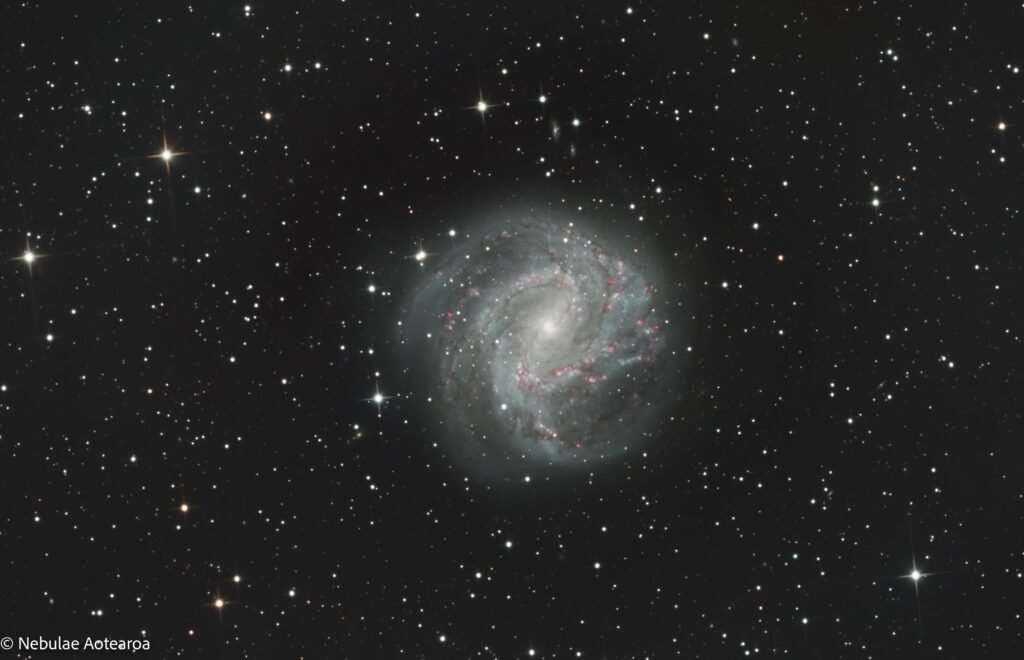
M83 — The Southern Pinwheel Galaxy
RA/Dec (J2000): 13h 37m, −29° 52′
Constellation: Hydra
Other designations: NGC 5236, Caldwell 73
Historical Overview
The Southern Pinwheel Galaxy (M83) is a barred spiral galaxy, one of the closest and brightest spirals visible from Earth. It was discovered in 1752 by Nicolas-Louis de Lacaille from South Africa and independently catalogued by Charles Messier in 1781 (Messier 1781).
In the 20th century, M83 gained importance as a starburst galaxy—it shows intense star formation, with bright H II regions along its spiral arms. It has hosted at least six recorded supernovae, more than most galaxies, making it a laboratory for studying stellar death.
Radio and infrared surveys reveal a bar structure funneling gas toward the core, feeding bursts of new stars. Its spiral structure, dust lanes, and supernovae make it a popular astrophotography target.
Key Facts
- Type: Barred spiral galaxy.
- Distance: ~15 million light-years.
- Supernovae: At least 6 in the past century.
- Scientific importance: Key galaxy for studying starbursts and spiral structure.
References
Tully, R. B. (1988). Nearby Galaxies Catalog.
Lacaille, N. L. de (1755). Catalogue des Étoiles Australes.
Messier, C. (1781). Catalogue des Nébuleuses et des Amas d’Étoiles.