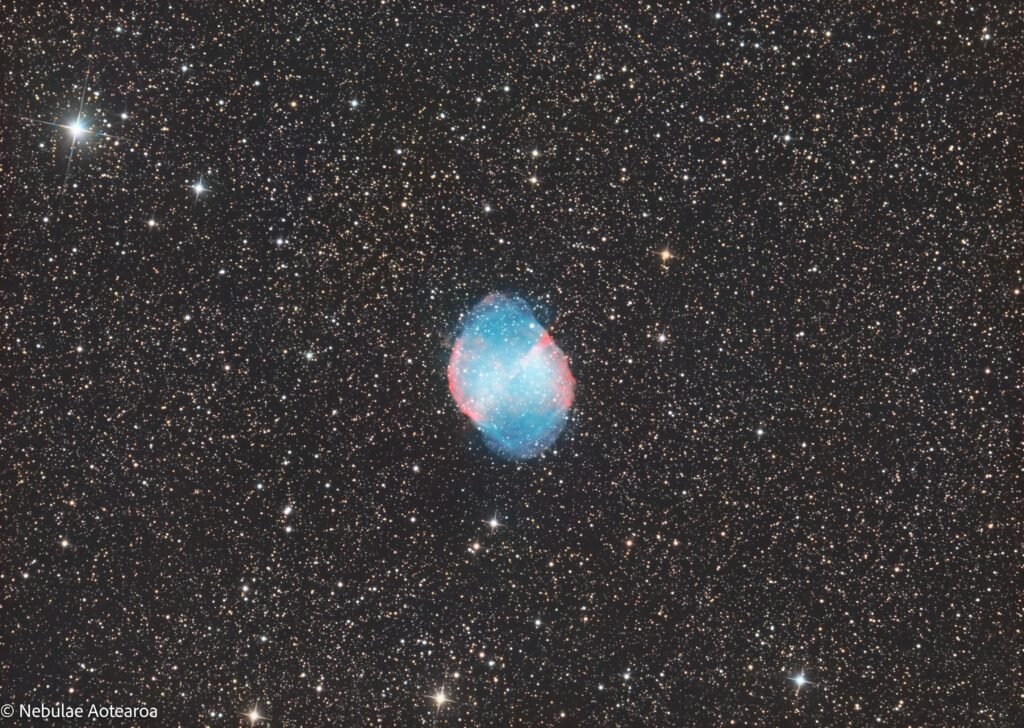
M27 — The Dumbbell Nebula
RA/Dec (J2000): 19h 59m 36s, +22° 43′ 16″
Constellation: Vulpecula
Other designations: NGC 6853, Caldwell 15
Historical Overview
M27, the Dumbbell Nebula, was the first planetary nebula ever discovered, found by Charles Messier in 1764 while cataloguing comet-like objects (Messier 1764).
In the 19th century, astronomers like William Huggins (1864) used spectroscopy to show that planetary nebulae like M27 consist of ionized gases, not stars. This was a turning point in understanding nebulae. Photographs by Isaac Roberts in the 1880s revealed its distinctive hourglass or “dumbbell” shape.
Modern studies show M27 is a dying Sun-like star ejecting its outer layers ~9,000 years ago. The central white dwarf is one of the hottest known, illuminating a shell of glowing oxygen and hydrogen gas.
Key Facts
- Type: Planetary nebula.
- Distance: ~1,360 light-years.
- Size: ~2.5 light-years across.
- Scientific importance: Prototype for planetary nebula studies; key historical object.
References
O’Dell, C. R. et al. (2002). The Structure and Evolution of the Dumbbell Nebula. AJ, 123, 3329.
Messier, C. (1764). Catalogue des Nébuleuses et des Amas d’Étoiles.
Huggins, W. (1864). On the Spectra of Some of the Nebulae. Phil. Trans. R. Soc. London.