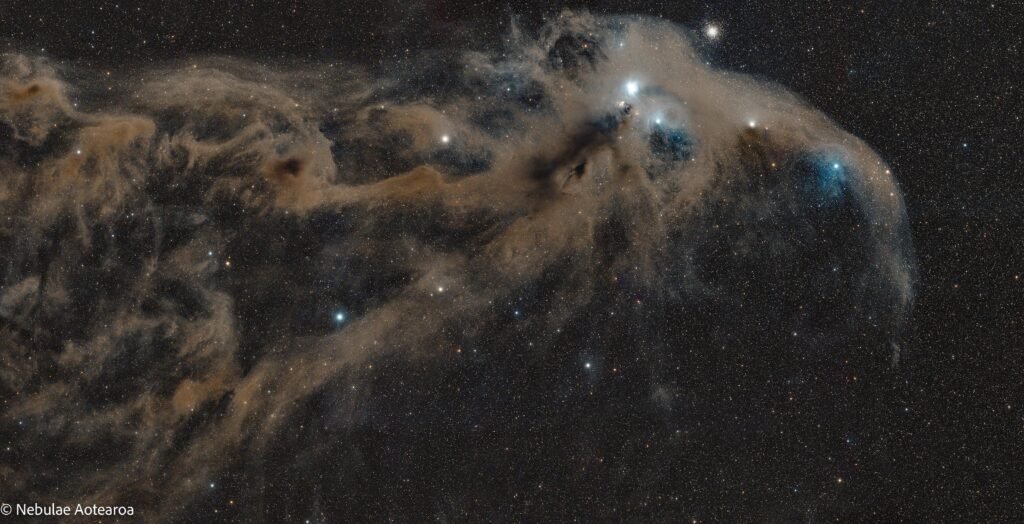
The Anteater Nebula — Dark Nebula in Musca
RA/Dec (J2000): 12h 13m, −71° 20′ (approx.)
Constellation: Musca
Other designations: Dark Nebula complex in the Musca region (including DC 303–49.0).
Historical Overview
The Anteater Nebula is a striking dark nebula in the constellation Musca. Its name comes from its elongated shape, which resembles an anteater in astrophotographs. Unlike bright emission nebulae, dark nebulae are visible because they block background starlight from the Milky Way.
It was first recognized in the early 20th century through the pioneering dark cloud surveys of Edward Emerson Barnard, who systematically photographed dark nebulae (Barnard 1927). Later southern sky surveys identified the Musca dark nebulae as dense regions of molecular gas.
The Anteater Nebula lies close to the famous Coalsack Nebula, forming part of a chain of obscuring dust lanes. Radio and infrared studies revealed that it contains cold molecular hydrogen and dust, with embedded protostars still in the earliest phases of stellar evolution (Bourke et al. 1995).
Key Facts
- Type: Dark nebula.
- Distance: ~600 light-years.
- Scientific importance: Contains Bok globules and protostars; nearby star formation site.
- Visibility: Best observed in wide-field astrophotography of the southern Milky Way.
References
Dutra, C. M. & Bica, E. (2002). Southern Dark Nebulae Catalog. A&A, 383, 631.
Barnard, E. E. (1927). A Photographic Atlas of Selected Regions of the Milky Way. Carnegie Institution.
Bourke, T. L. et al. (1995). Star Formation in Southern Dark Clouds. MNRAS, 276, 1067.