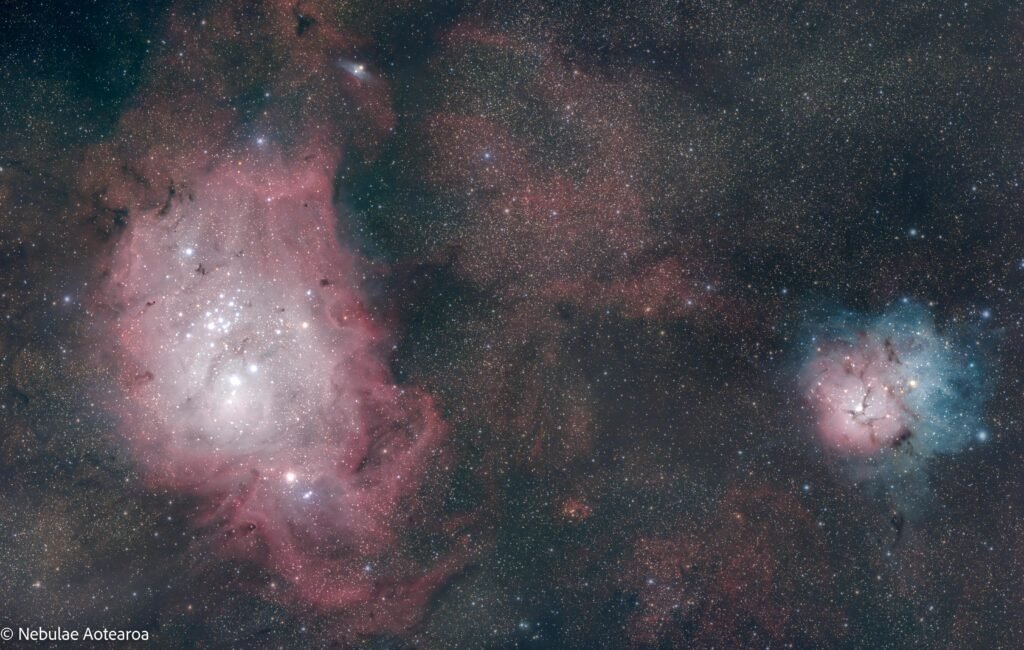
M8 – The Lagoon Nebula
The Lagoon Nebula (Messier 8, NGC 6523), [the nebula to the left in the image], is a vast star-forming region in the constellation Sagittarius, about 4,100 light years away. Spanning over 110 by 50 light years, it is one of the brightest emission nebulae visible to the naked eye from dark skies. Discovered by Giovanni Battista Hodierna before 1654 and later catalogued by Charles Messier in 1764, it glows primarily in hydrogen-alpha light from hot young stars energizing the surrounding gas.
Inside lies the Hourglass Nebula, a particularly bright pocket of ionized gas, as well as numerous Bok globules (dense clouds where new stars are forming). M8 is part of the Milky Way’s Sagittarius Arm, offering a glimpse into the ongoing cycle of stellar birth.
M20 – The Trifid Nebula
The Trifid Nebula (Messier 20, NGC 6514), [the nebula to the right in the image], is another spectacular star nursery, located about 5,200 light years away, also in Sagittarius. It is famous for its three dark dust lanes that divide the glowing pink emission nebula, giving it the name “Trifid.” First recorded by Charles Messier in 1764, M20 is a rare combination of three types of nebula in one object:
- Emission nebula (red hydrogen gas)
- Reflection nebula (blue starlight scattered by dust)
- Dark nebula (obscuring dust lanes)
At its heart, a cluster of hot young stars illuminates and sculpts the surrounding clouds. The Trifid is smaller than the Lagoon, about 21 light years across, but its striking contrast of colors and textures makes it a favorite astrophotography target.
Together, M8 and M20 form one of the most beautiful star-forming regions in the summer Milky Way, best observed from the Southern Hemisphere or low northern latitudes.