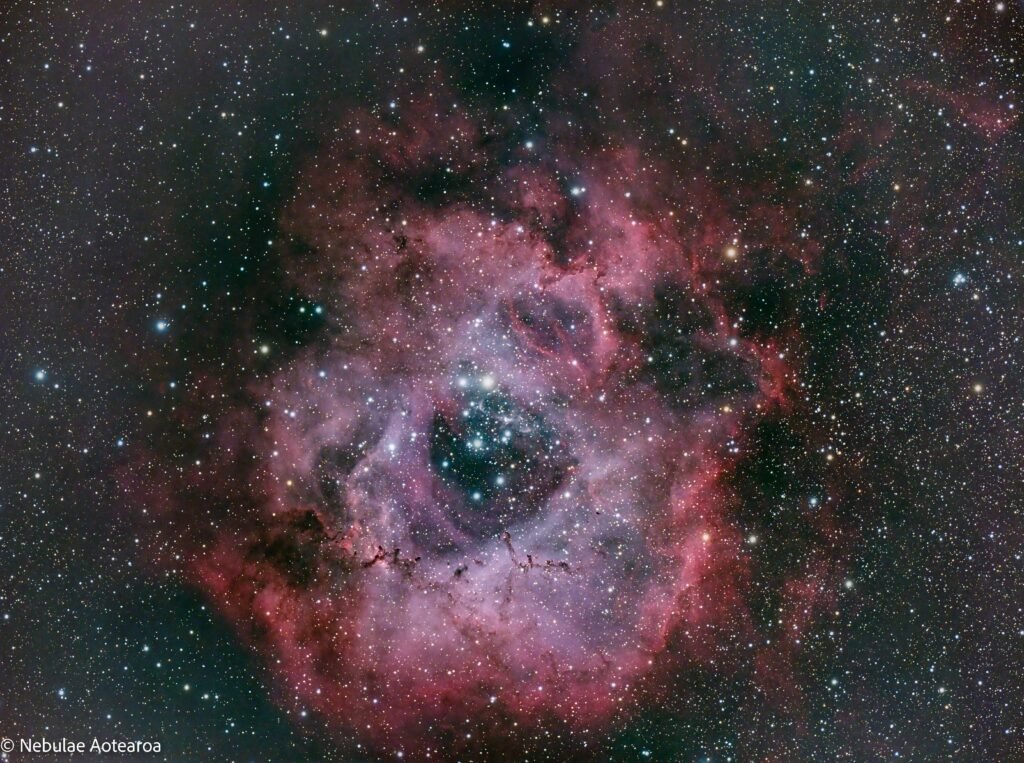
NGC 2244 — The Rosette Cluster
RA/Dec (J2000): 06h 31m 55s, +04° 56′ 34″
Constellation: Monoceros
Other designations: Caldwell 50, part of the Rosette Nebula complex (Caldwell 49).
Historical Overview
The open cluster NGC 2244 lies at the center of the Rosette Nebula, a vast H II region of gas and dust. Discovered by John Flamsteed in 1690 (though only recorded more carefully later), its brightest stars were catalogued during the 18th century. The cluster itself was officially catalogued by William Herschel in 1784 (Herschel 1786).
The nebula and cluster together became the subject of 19th-century photography, particularly after Isaac Roberts captured images in the 1890s, revealing the flower-like appearance of the Rosette. In the 20th century, spectroscopy showed that the cluster’s young, hot O-type stars are the primary ionizing sources illuminating the Rosette Nebula (Johnson 1962).
NGC 2244 is estimated to be only 2–6 million years old, making it a young open cluster still partly embedded in the gas cloud from which it formed. Its stars are dispersing the nebula with strong stellar winds and radiation.
Key Facts
- Age: ~2–6 million years.
- Distance: ~5,200 light-years.
- Stars: Contains multiple O-type and B-type stars.
- Scientific importance: Nearby laboratory for studying massive star feedback on H II regions.
References
Johnson, H. M. (1962). The Excitation of the Rosette Nebula. ApJ, 135, 575.
Herschel, W. (1786). Catalogue of Nebulae and Clusters of Stars. Phil. Trans. R. Soc. Lond.
Roberts, I. (1895). Photographs of Nebulae. Astronomical Society Transactions.