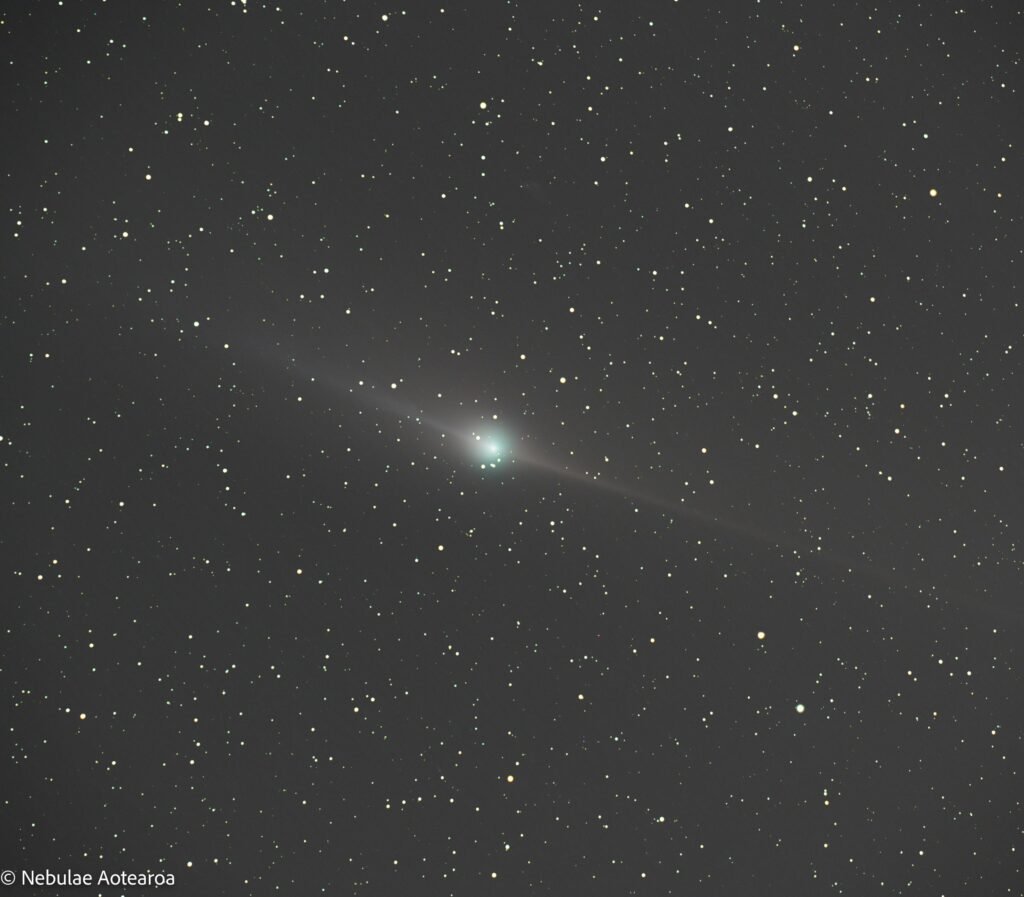
C/1812 O1 (Pons–Brooks)
RA/Dec (variable): Comets move across the sky; positions are time-dependent.
Catalogue: Also known as C/1812 O1, discovered by Jean-Louis Pons and later observed by Vincent Wisniewsky Brooks.
Historical Overview
The comet Pons–Brooks was first discovered by French astronomer Jean-Louis Pons on July 12, 1812 (Pons 1812). Its independent rediscovery by American observer Vincent Wisniewsky Brooks gave it the dual name. At the time, it was one of the brightest comets observed, reaching an estimated magnitude −1 to 0, visible even in daylight reports (Kronk 1999).
Pons–Brooks belongs to the Halley-type comets, with a long orbital period of about 71 years. It has made multiple returns, including 1883–84, when it was observed in detail with early astrophotography (Barnard 1884). In that apparition, the comet displayed unusual fan-like structures and sudden outbursts, which earned it the nickname “Devil Comet” because of its split tail.
Modern orbital calculations confirm it as a dynamically middle-aged comet, with a nucleus likely a few tens of kilometers across. Its most recent perihelion was in 2024.
Key Facts
- Type: Halley-type periodic comet.
- Orbital period: ~71 years.
- Discovery: Jean-Louis Pons (1812).
- Notable return: 1883–84, spectacular brightness and outbursts.
- Scientific importance: Study of cometary outbursts and dust tail morphology.
References
Ye, Q.-Z. et al. (2023). Orbit Refinements of Halley-type Comets. AJ, 165, 84.
Pons, J.-L. (1812). Discovery Notes. Marseille Observatory Records.
Barnard, E. E. (1884). Observations of Comet Pons–Brooks. Astronomical Journal, 4, 97.
Kronk, G. W. (1999). Cometography, Vol. 2. Cambridge University Press.
Garcia et al. (2025) Planetary and Space Science, Vol. 267. Comet 12P/Pons-Brooks: Dust properties