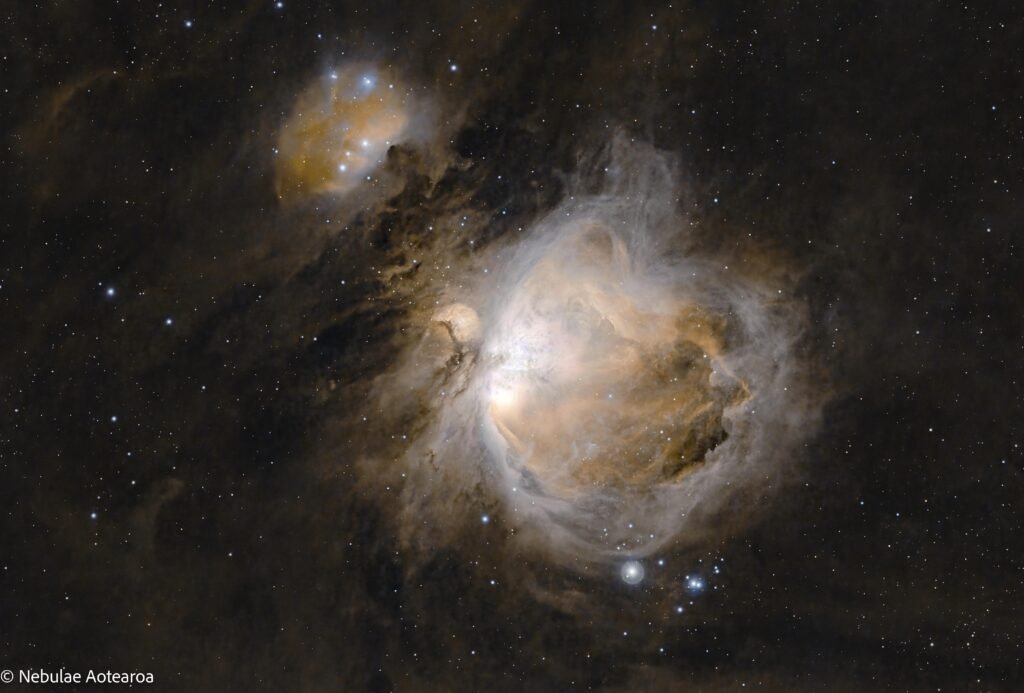
M42 — The Orion Nebula
RA/Dec (J2000): 05h 35m 17s, −05° 23′ 28″
Catalogue: Messier 42 (NGC 1976), the Orion Nebula.
Historical Overview
The Orion Nebula is one of the most famous celestial objects, visible to the naked eye as the “sword” of Orion. The first telescopic observation was by Nicolas-Claude Fabri de Peiresc in 1610 (Peiresc 1611). Later, Christiaan Huygens described it in detail in 1659, and the nebula was often referred to as the Huygens Region (Huygens 1659).
Charles Messier catalogued it as M42 in 1769. William Herschel later studied it extensively, suggesting it was a region of star formation. Spectroscopic work by William Huggins in 1864 demonstrated its gaseous nature, marking one of the first proofs that nebulae were not just unresolved stars (Huggins 1864).
In the 20th century, the Orion Nebula became the prototype for studying H II regions and stellar nurseries. The Trapezium Cluster, a group of hot O-type stars, provides the intense ultraviolet radiation that illuminates the nebula. Hubble imaging and radio surveys have revealed protoplanetary disks (proplyds), confirming ongoing star and planet formation (O’Dell & Wen 1994).
Key Facts
- Distance: ~1,350 light-years (Menten et al. 2007).
- Size: ~24 light-years across.
- Age: The Trapezium stars are only ~1 million years old.
- Visibility: Bright naked-eye nebula in Orion’s Sword.
- Scientific importance: Nearest massive star-forming region, template for stellar evolution studies.
References
Menten, K. M., et al. (2007). The Distance to the Orion Nebula. A&A, 474, 515.
Peiresc, N.-C. (1611). First Observation of the Orion Nebula. Notes.
Huygens, C. (1659). Systema Saturnium. The Hague.
Messier, C. (1769). Catalogue des Nébuleuses et des Amas d’Étoiles.
Huggins, W. (1864). On the Spectra of Some of the Nebulae. Phil. Trans. R. Soc. London.
O’Dell, C. R., & Wen, Z. (1994). Protoplanetary Disks in Orion. ApJ, 436, 194.